
Freedom Has an Address: Juneteenth 2026 in Dane County, Wisconsin
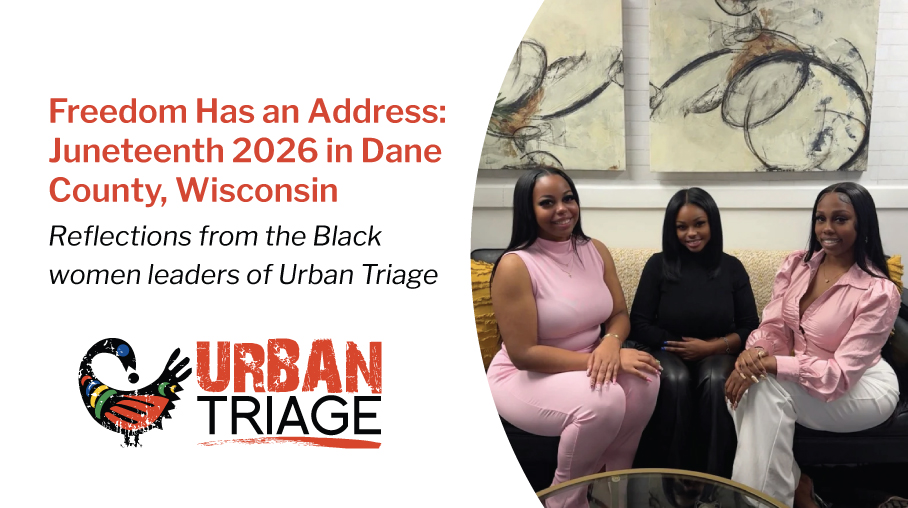
Reflections from the Black women leaders of Urban Triage
Freedom has an address.
For the Black women who show up every day at Urban Triage in Dane County, freedom is not an abstraction or a date on a calendar. It is a signed lease after months of housing instability. It is a young person who finally has somewhere safe to land after school. It is someone walking home from incarceration through an open door instead of a closed one. It is a family that stops surviving and starts building.
Juneteenth marks the day in 1865 when enslaved people in Galveston, Texas, finally learned they were free, more than two years after the Emancipation Proclamation. Freedom had been declared. It just hadn't been delivered. More than 160 years later, that gap between what's promised and what actually reaches people is still the whole job.
And in Wisconsin, the gap is canyon-wide. This is one of the most racially disparate states in the country, and Dane County is one of the hardest places in it to be Black, measured in housing, wealth, incarceration, health, and who gets to grow up with a fair shot. None of that is an accident. It is the predictable result of generations of decisions about whose neighborhoods got invested in and whose got left behind.
This Juneteenth, we asked the Black women across Urban Triage what freedom looks like from where they stand. Their answers were honest, sharp, and rooted in the Dane County communities they serve every day. Together, they say one thing clearly: freedom is not something you inherit. It is something you build.
Freedom, in practice
At Urban Triage, freedom gets measured in outcomes you can name: a lease, a meal, a job, a future.
"Every grant application I write represents something real on the other side of it," says Rachel Rogers, Urban Triage's Grant Manager. "A family that stays housed. A young person who has somewhere to go after school. Someone coming home from incarceration who gets a real shot at stability."
That is the difference between charity and change. Charity hands you something for today. Freedom builds the conditions where you don't have to ask again.
What it costs to lead while Black in Madison
Leading as a Black woman in Madison means living in the tension between being too visible to relax and too overlooked to be heard, and showing up anyway.
"Being a Black woman leader in Madison means carrying both the weight and the brilliance of my community," says Shanna Sharp. "It means showing up in spaces where our voices have been overlooked and refusing to shrink." Rachel Rogers puts it plainly: it means "operating in spaces that were not designed for me and refusing to adjust myself to fit them."
That refusal is the work. As one leader on our team described the responsibility she carries, it means "being a symbol of hope for the young Black girls that come after me, letting them know that no matter what life throws at them, they are still destined for greatness, and their value is unmatched."
Lived experience is expertise
The strongest leaders here tend to be the ones who know the struggle from the inside. Urban Triage is built on the belief that the people closest to the problem are closest to the solution.
Shanna Sharp is the proof. She came to Urban Triage during one of the hardest seasons of her life, navigating poverty, trauma, and a schizophrenia diagnosis, learning firsthand what it feels like to be invisible inside the very systems built to help. That experience didn't disqualify her. It became her expertise.
"I know what it feels like to fight for stability, dignity, and visibility," she says. "I lead from lived experience… I keep doing this work because I refuse to let anyone feel as invisible as I once did."
Denyse, another leader on our team, names the turning point that reshaped how she works: "I realized we were just putting Band-Aids on bullet wounds." The same families kept coming back with the same crises because relief alone would never be enough. "Real leadership means digging up the root causes, disrupting the status quo, and fighting for systemic power, not just handing out temporary fixes."
That is Urban Triage's whole posture: we treat systems, not symptoms.
Resilient — not broken
Here is what we will not do: describe the people we serve as broken.
"The people Urban Triage serves are some of the strongest, most resourceful, most resilient individuals you will ever meet," Shanna says. "They are surviving systems that were never designed for them." Rachel adds, "The communities we serve are not defined by their challenges. They are defined by their resilience. What many people need is not judgment or charity. They need fair opportunities, stable resources, and systems that recognize their humanity."
Our role is not to rescue anyone. It is to clear the barriers, open the doors, and stand alongside families as they build the futures they already deserve.
And no, we don't only serve Black families. We serve everyone who walks through our doors. If we don't have what you need, we help you find it. Turning people away has never been the mission. Building pathways forward is.
Now let's name what's happening
You can't honestly talk about freedom in Wisconsin in 2026 without addressing the parts that don't fit on a greeting card.
Over the past year, this work lost millions of dollars in federal funding — not because the need got smaller, but because a new administration decided that communities like ours weren't worth the investment. Let's be clear about what that is. It isn't a budget line. It's a decision about who gets to be free, made by people who will never sit in our drop-in hours and never meet the families on the other side of those dollars.
So here is the systems analysis, in plain language: the disparities Dane County is famous for were deliberately built, and they are being deliberately deepened. As Denyse says, "Our folks aren't dealing with personal shortcomings; they are dealing with the heavy weight of navigating a system that wasn't built for them to win." Rachel names the sleight of hand we keep falling for: "We have a cultural habit of framing outcomes as the result of individual decisions while quietly ignoring the infrastructure, policy history, and public investment that made some neighborhoods thrive and others struggle."
When you misdiagnose the problem, you build the wrong solution. We refuse to misdiagnose it. And we refuse to fold.
"Urban Triage does what too few are willing to do — treat root causes, not just symptoms. When federal funding walked away from this work, the need didn't. That's exactly why community investment matters now, and why we stand behind them."
— Dana Pellebon, Executive Director, RCC: Sexual Violence Resource Center
Whose shoulders we stand on
Ask the women of Urban Triage who shaped them, and they don't name celebrities. They name aunties. Grandmothers. Mothers. Neighbors.
"The Black women who inspire me most aren't in history books or on social media feeds," Denyse says. "They're the aunties, mothers, and grandmothers in our neighborhoods. They are the original community organizers. They taught me that leadership isn't about a title or a microphone. It's about consistency, protection, and unconditional care for the collective."
That lineage is the engine. As Denyse puts it: "Giving up isn't an option because I know whose shoulders I'm standing on. Black women have been making bricks out of straw for generations." That's not a metaphor here. It's a job description.
What we're building next
Freedom delayed is freedom denied — but freedom is also not self-executing. It takes leadership, advocacy, investment, and community, on purpose, again and again.
So this is the part where we stop reflecting and start recruiting. Urban Triage is not retreating in the face of lost funding — we are building toward a future this community owns and sustains, with revenue streams rooted right here: housing, agriculture, education, and our own Wisconsin-grown enterprises. We are choosing to be funded by the people who believe freedom should have an address.
That starts with one room, one afternoon.
Reclaim the crown with us — The Golden Hour, July 19
The Golden Hour: Reclaiming Our Crown is Urban Triage's summer gala-style brunch — Sunday, July 19, 2026, 2:30–7:00 PM, on the rooftop of The Madison Club, 5 E. Wilson Street. Expect a Royal Welcome cocktail hour, the Brilliance Banquet, and The Crowning — a ceremony honoring two of Madison's most prolific Black organizations and two of the city's most trusted truth-tellers, Henry Sanders of Madison365 and Bianca Martin of City Cast Madison — before DJPAIN1 takes us home. Less Noise, our full-spectrum, Wisconsin-grown hemp line, debuts on-site, and every product dollar feeds our agriculture work.
Come, draped in color. Every seat at the table means something, and every ticket is a brick in the future we're building.
→ Reserve your seat at The Golden Hour — seating is limited.
Can't make it on the 19th? You can still invest in the work at the level that's right for you:
- Sponsor the gala and put your name behind Black brilliance in Madison.
- Make a donation that keeps families housed, fed, and moving forward.
- Subscribe to our updates so you never miss what's next.
Because freedom is not a destination. It's a practice. And the work continues — with you in the room.
Frequently Asked Questions
What is Urban Triage? Urban Triage is a Black-led, community-centered nonprofit based in Dane County, Wisconsin. We provide housing support, food access, agriculture, youth development, education, and advocacy designed to help individuals and families heal, build stability, and lead within their communities. Our work centers on self-sufficiency, self-knowledge, and systemic change.
Does Urban Triage only serve Black people? No. Urban Triage serves everyone who comes to us. We are Black-led and culturally grounded, and we welcome and support all community members. If we don't have a resource you need, we help connect you to one.
Why are racial disparities so severe in Dane County and Wisconsin? Wisconsin is one of the most racially disparate states in the country, with deep gaps in housing, wealth, health, education, and incarceration. These outcomes reflect decades of policy decisions and public investment patterns —not individual failures.
What is the Golden Hour gala? The Golden Hour: Reclaiming Our Crown is Urban Triage's gala-style brunch on Sunday, July 19, 2026, at The Madison Club in downtown Madison. It celebrates Black brilliance, honors local leaders and organizations, and raises funds for Urban Triage's programs.
How can I support Urban Triage? Buy a ticket to The Golden Hour, sponsor the event, make a donation, volunteer, or subscribe to our updates. Every level of support fuels housing stability, food justice, agriculture, and community power in Dane County.
Stay Connected with Urban Triage
Join our mailing list to receive the latest news, events, and exciting opportunities from Urban Triage, straight to your inbox!