
Aging Out of Foster Care in Dane County: How Urban Triage's Emerging Adult Home Creates Pathways to Independence
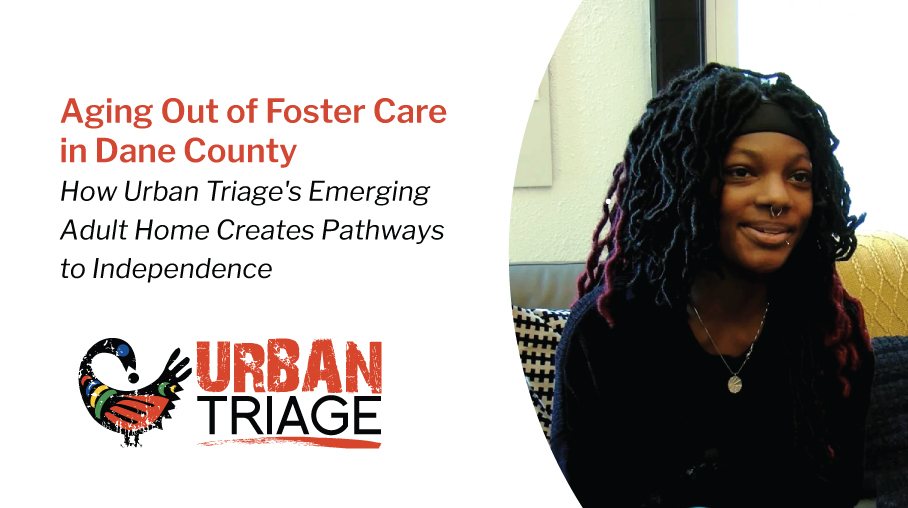
Most young adults have someone to call when the floor drops out. Someone who covers rent when the month runs long. Someone who picks up the phone after a brutal shift. Someone whose couch is always an option while they figure out the next move.
Young people aging out of foster care are handed adulthood without any of that. At Urban Triage, we believe no young person should have to navigate that transition alone.
At 18, sometimes 21, the system that was supposed to protect them simply stops. Overnight, they're expected to find housing, hold a job, manage money, and navigate a world that gives them no margin for a single mistake. Alone.
As one young person in our program put it: "Before moving into the Emerging Adult Home, I was constantly worried about where I would sleep and what would happen next."
That worry isn't a personal failing. It's the predictable result of the system’s design.
A pipeline, not bad luck
Roughly 15,000 young people age out of foster care in the United States every year — most of them without a family to fall back on. What happens next is not a mystery, and it is not their fault. It's documented.
Within the first years of aging out, 22 to 30 percent experience homelessness — and by age 26, that number climbs as high as 46 percent. For everyone else, the lifetime rate sits around 4 percent. By their mid-twenties, only 8 to 12 percent of young adults with foster care experience have earned a college degree, compared to nearly half of their peers. Only about half are employed at 24. This is not a series of bad individual choices. It's a pipeline that runs, with grim reliability, from a system that ends at 18 toward homelessness, unemployment, and incarceration.
And like nearly every system in this country, it does not fail everyone equally. Black children are funneled into foster care at far higher rates — about 1 in 9, versus 1 in 17 children overall — and Black youth leaving care are roughly three times more likely to become homeless. Wisconsin is one of the most racially disparate states in the nation, and those odds land hardest on the young people right here at home.
Here's the part the data also makes clear: none of this is inevitable. The same research that maps the pipeline shows the way out of it. Young people who have stable housing, a caring adult in their corner, and real independent-living support are dramatically less likely to end up homeless — by some measures, more than 40 percent less likely. The outcomes aren't fixed. The support is the variable.
That's the whole premise of the Emerging Adult Home.
Why this matters in Dane County
Across Wisconsin, young adults leaving foster care face steep barriers to housing stability, employment, and education. In Dane County, rising housing costs make an already brutal transition even harder. A young person aging out here isn't just looking for support — they're looking for an affordable place to live in one of the tightest, most expensive rental markets in the state, often with no rental history, no co-signer, and no family to call.
Without stable housing and supportive relationships, many young people are forced to navigate adulthood without the resources most families quietly provide well into their twenties. The gap doesn't close on its own. Someone has to build the bridge.
That's where Urban Triage comes in
Urban Triage's Emerging Adult Home exists to be the thing these young people were never given: a soft place to land and a real launchpad. Built for young adults transitioning out of foster care, the program provides stable housing, life-skills development, mentorship, and wraparound support — so that residents can stop bracing for the next crisis and start building a future.
For many residents, a safe place to sleep is the first thing they've had that nobody can take away. And from that foundation, everything else becomes possible.
We believe stability comes before success
Society tends to ask young people to prove they're responsible before it offers them support. Urban Triage believes the opposite.
Stability creates responsibility. Housing creates opportunity. Support creates independence.
When a young person knows where they'll sleep, who they can call, and where they belong, they are far more likely to reach their educational, employment, and personal goals. We don't make young people earn the basics. We give them the foundation first — and watch what they build on it.
More than a place to live
We know housing alone isn't enough. Aging out doesn't just take away an address — it takes away the network most people lean on for their entire twenties. So the Emerging Adult Home is built to put that network back, with wraparound support that meets young people where they are:
- Independent living and life-skills development
- Budgeting and financial literacy
- Employment readiness and workforce development
- Educational support and goal planning
- Housing navigation and landlord engagement
- Trauma-informed care and emotional wellness support
- Mentorship and community-building
- Connections to the resources and services that open doors
Residents work alongside staff who help them navigate the obstacles in front of them while building the confidence and skills to clear the next ones on their own.
Belonging is the intervention
Many of the young people who come to us were handed instability by the system — moved from placement to placement, separated from siblings, cut off from anyone who stayed. That isolation isn't who they are. It's what was done to them. And it's exactly what the Emerging Adult Home is designed to undo.
The Home creates room for connection, belonging, and growth — peers and staff who genuinely show up, and relationships that don't disappear when a case file closes. As one resident shared:
“To feel that connection and to actually feel that support, definitely talking to people that have been through something, or at least something similar. It helps me feel at ease knowing that there are people out there that have been through it, and so I’m not alone.”
What we're building — and why it matters
At its core, the Emerging Adult Home is about possibility. With housing, guidance, and people in their corner, young people can spend less energy surviving and more energy building the life they deserve. Every young person who leaves our program housed, working, and connected is a young person the pipeline didn't claim.
The question is not whether young people aging out of foster care deserve support.
The question is whether we are willing to build the systems that provide it.
At Urban Triage, we have chosen our answer. Here's how you join us.
Get involved
Whether you've got five minutes or a building, there's a way to plug in.
Right now: The most direct way to invest in this work is The Golden Hour: Reclaiming Our Crown — Urban Triage's summer gala-style brunch on Sunday, July 19, 2026 at The Madison Club. Every ticket fuels programs like the Emerging Adult Home. Reserve your seat →
And year-round, you can:
- Refer a young person. If you know someone aging out of foster care in Dane County who needs housing and support, connect them to us.
- Partner as a landlord or housing provider. Safe, stable units are the foundation on which everything else is built. If you have housing, you have a role here.
- Become a mentor. Sometimes the whole difference is one adult who stays. Volunteer your time and consistency.
- Donate or sponsor. Your investment keeps young people housed, supported, and moving forward.
- Subscribe to Urban Triage updates so you never miss a way to help.
The Emerging Adult Home is part of Urban Triage's broader commitment to cultivating healthy youth, strengthening families, and building pathways to self-sufficiency across Dane County. To learn more, make a referral, support the work, or get involved, visit urbantriage.org.
Frequently Asked Questions
What is Urban Triage's Emerging Adult Home? The Emerging Adult Home is a Dane County, Wisconsin program for young adults transitioning out of foster care. It provides stable housing, life-skills development, financial literacy, employment and education support, trauma-informed care, and mentorship to help residents build independence and long-term stability.
What does "aging out" of foster care mean? "Aging out" refers to young people who leave the foster care system at 18 (or up to 21 in states that extend care) without being reunited with family, adopted, or placed in permanent guardianship. They transition to adulthood without the family safety net most young people rely on.
Why do youth who age out of foster care face such hard outcomes? National research shows young people who age out experience much higher rates of homelessness, unemployment, and incarceration, and much lower rates of college completion, than their peers. These outcomes are driven by the loss of family support and stable housing at a critical transition — not by personal failure — and they fall disproportionately on Black youth, who are overrepresented in the system.
How can I help young people aging out of foster care in Dane County? You can refer a young person to the Emerging Adult Home, partner as a landlord or housing provider, become a mentor, donate or sponsor, or support Urban Triage's annual gala. Every level of involvement directly supports local youth.
How do I contact Urban Triage about the Emerging Adult Home? Visit urbantriage.org to learn more about the program, make a referral, or get involved.
Stay Connected with Urban Triage
Join our mailing list to receive the latest news, events, and exciting opportunities from Urban Triage, straight to your inbox!