Opinion: The Truman Show on the Isthmus
October 12, 2026
On July 22, Madison police murdered Corey Ruiz, a 38-year-old unhoused Black man, on Williamson Street. None of the four officers wore body cameras. We know how he died because neighbors pulled out their phones.
Today, the only person in city government with independent power to investigate that murder is Interim Independent Police Monitor Aeiramique “Meeka” Glass. On October 20, the Common Council will vote on whether to fire her “effective immediately.”
The timing is no coincidence. White supremacy rarely announces itself in Madison. It shows up in procedure, in tone policing and in polite press releases, and it runs the same playbook every time a Black woman gets close to the truth. Let’s name the plays.
Play one: Change the subject.
Glass found what this city spent years refusing to see. Her office concluded that Madison officers caused the 2024 death of Richard Lee Johnson, a 32-year-old unhoused Black man, through prone restraint, force, and failure to render aid. An independent forensic pathologist found the medical examiner’s overdose ruling was wrong, and that ruling was the foundation for clearing the officers.
Where is that story now? Gone. In its place is a running commentary on Meeka Glass, from her words to her temperament to her paperwork. When the evidence points at the system, the system points at the messenger.
Play two: Starve it, then blame it for being hungry.
Madison created this office in 2020, after Paul Heenan, after Tony Robinson, after years of community organizing. Then the city funded it like an afterthought: $405,000 and three staff to watch a police department with a budget over $98 million. Alders tried to defund the office in two straight budgets, once proposing to move its money to body cameras. This fall they rejected a $28,500 increase.
Now the same leaders say the office isn’t delivering. You can’t underfund an institution for six years and then act shocked that it’s stretched thin. I know this pattern personally. I’ve held city contracts where Madison kept the paper but not the responsibility. The city stayed hands-off until it wanted control, then suddenly cared a great deal about my “compliance.”
Play three: Manufacture a process.
The resolution calls Glass’s performance a “breach of contract,” though she says she never signed a contract. It leans on an “employment review” written by the city attorney, not the Police Civilian Oversight Board, which, under the ordinance, is her actual supervisor. Glass found out about that review from a reporter’s email on a Friday night.
This is how manufactured process works. You build a paper trail, call it accountability, and hand it to the press before the person it targets has even seen it.
Play four: Tell us not to believe our own eyes.
We watched Corey Ruiz die. Bystanders filmed police shooting him three times, including in the head, on a busy street in broad daylight. Our city’s answer was that we need more body cameras.
You’ll hear that Corey had a knife. You’ll hear that the Tasers failed. Pay attention to what those details are doing. Four officers were on one man with a bicycle, and the story they built still ends with Corey dead in the street. Facts arranged to justify a killing are not the same as accountability for one.
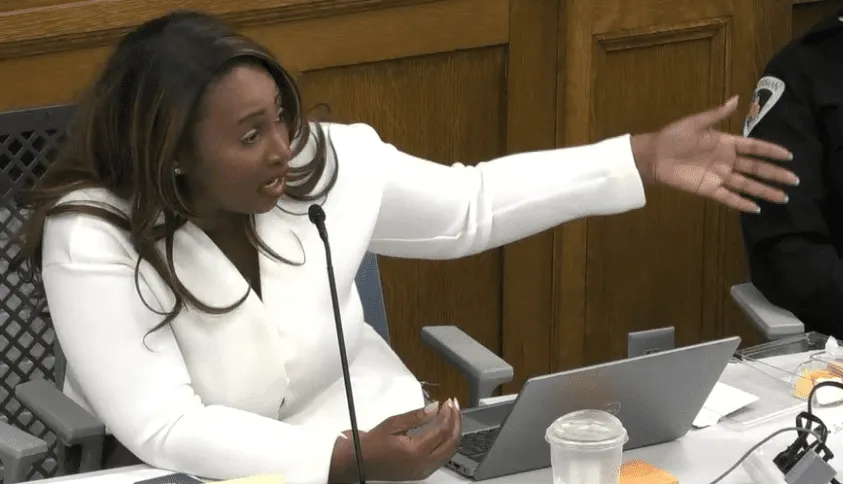
Then they did it again with Meeka. Watch the drone footage the police released themselves. An officer steps in front of her to block her path. Her arm is out while she asks for a badge number. Police reach for her and grab her, and she walks away bleeding. That is the “violence” this city keeps talking about.
We never lacked cameras. We have the footage. People see what they want to see, especially when the person on screen is Black, and even more so when she’s a Black woman.
Play five: Police her tone.
Yes, she said she’d burn this city down. She said it, bleeding, minutes after police attacked her at an encampment sweep that followed a murder. People got angrier about a metaphor than about a body. That’s the tell.
What really offends them is that she’s matter-of-fact, certain, and unapologetic about her intelligence. She doesn’t perform gratitude for the seat. Black women know this script well. We’re hired for our competence and punished for our confidence. I’ve been called “too aggressive” in rooms where I was the only one holding data, and I’ve watched the media cover my organization’s tone more closely than its outcomes.
Play six: Criminalize the witness.
A Black woman, caught on camera grieving and injured, was recast as the violent one, and a police officer walked away with a four-year restraining order against her. On the morning of the hearing, Glass asked in writing to reschedule. The court said no, she wasn’t in the room, and granted the order. A protective order won against an empty chair is not a verdict of guilt.
Compare that to what Black women get. For years, a white man has harassed Black women across this city, and I’m one of them. He went after me and my board members, made false allegations, and recruited others to spread his stories. Nobody in power stopped him. Madison police called me more than once, asking me to give him what he wanted.
Council President Sabrina Madison, a Black woman, went to court with evidence after three years of his contact. A judge said it wasn’t enough. So here is Madison’s justice system at work: a Black woman with receipts gets “not enough proof,” while a police officer facing a Black woman gets an empty chair as proof enough.
Play seven: Use our own faces.
Sabrina Madison is a sponsor of this resolution, alongside Alders Will Ochowicz, Yannette Figueroa Cole, Tag Evers, and Regina Vidaver. Eighteen alders voted to advance it. Only Carmella Glenn and Julia Matthews said no.
Misogynoir doesn’t need a white face to carry it out. White supremacy has always recruited people of color to enforce its rules, because a Black signature makes the outcome look fair. These progressive leaders passed an ordinance forbidding anyone from undermining the monitor’s independence, and now they’re undermining it themselves. The law binds the people it was written to protect and bends for the people who wrote it.
Why now?
Because Glass isn’t asking for permission. The ordinance promises her unfettered access to police records and the power to subpoena. She has sued for the records in Corey’s murder. She overturned the official story in Richard Lee Johnson’s death. And an oversight board with community seats stands behind her.
What scares them is her reach, not her tone. For the first time, someone outside the police department can look inside it, and she isn’t flinching.
So the city reached for the oldest tool it has: discredit the Black woman, then dismantle what she built. We like to pretend Madison is a different bird from the administration in Washington, but watch the actions. It’s the same bird with different agenda items, and the outcome is the same.
This is our Truman Show.
Madison is a beautifully lit set where everyone performs liberal values. We fund gear and patrols as “public safety” and ignore the housing crisis that kept putting Corey and Richard in contact with police. The moment someone steps into the painted sky, the director rewrites the script.
Protect Black women. Protect oversight.
In 1977, the Combahee River Collective, the Black feminist group of Barbara Smith, Beverly Smith, and Demita Frazier, wrote that if Black women were free, everyone would be free, because our freedom would require destroying every system of oppression. Defending Meeka Glass isn’t about one job. It’s about whether this city will let a Black woman hold power over the institutions that harm us.
Show up on October 20. Tell your alder to vote no, let Glass finish the Ruiz investigation, let the Police Civilian Oversight Board do its job, fund oversight like you mean it, and reopen Richard Lee Johnson’s case.
Madison doesn’t get to call itself progressive while it silences the woman telling the truth.
Stay Connected with Urban Triage
Join our mailing list to receive the latest news, events, and exciting opportunities from Urban Triage, straight to your inbox!