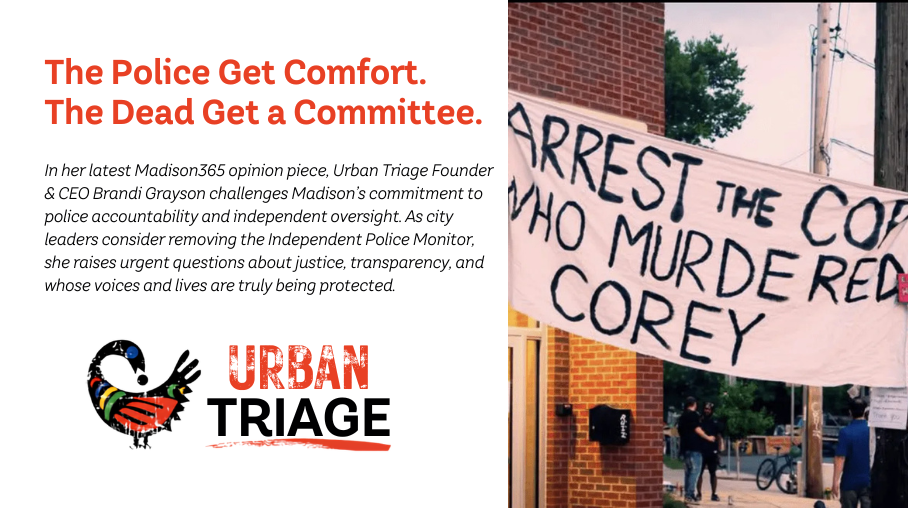
The Police Get Comfort. The Dead Get a Committee.
Gloria Johnson Vinson sat beside her son’s hospital bed and felt knots on the back of his head. The top of his skull was soft. Richard Lee Johnson died the next day, December 31, 2024. The medical examiner called it an accident. The district attorney cleared the officers, then took more than a month to tell his family.
Eighteen months later, one city official finally told her the truth: Madison police caused her son’s death.
That official is Interim Independent Police Monitor Aeiramique “Meeka” Glass. Nine alders have now announced they’ll vote Tuesday to fire her. Two more votes and she’s gone.
Each of them has explained why. Alder Noah Lieberman called it the hardest decision of his time in office. Alder Will Ochowicz, who wrote the resolution, says she walked away from her core job. Alder Dina Nina Martinez-Rutherford says Glass’s behavior makes her question her judgment.
I’m going to take them at their word. I’ve spent my life listening to institutions explain why a Black woman had to go, and I’ve learned the only respectful response is to check the receipts. So let’s do for these alders what this city has never been willing to do for its police. Put every claim on the stand. Test it against the record. See what survives.
One thing to keep in mind as we go: the entire point of oversight is that the people being watched don’t get to choose who watches them. That’s going to matter.
Exhibit A: The hiring delay
The claim: This is the main event. Glass was hired to find her permanent replacement, and she hasn’t. Ochowicz says the oversight board is creating a “legal fiction” so it can appoint her permanently, and that she asked the board to pause the search without telling the Council. Lieberman says he has no faith she would recruit someone else.
The record: Look at the calendar.
- June 9: The Council votes unanimously to extend Glass’s appointment through March 31, 2027, with finding a permanent monitor as her main job. Every single alder votes yes.
- June 15: Six days later, Glass releases findings that Madison police caused the death of Richard Lee Johnson through prone restraint, force and failure to render aid. The investigation began with a complaint from his mother, Gloria Johnson Vinson. Advocates point out that no one on the city payroll had ever found an officer at fault for a death before.
- July 22: Madison police kill Corey Ruiz. Glass goes after the evidence.
- August 4: Police attack her.
- August 31: City agency heads send a memo listing concerns about her.
- October 2: The deputy City Attorney sends another.
- October 6: The Council votes 18 to 2 to introduce a resolution firing her.
On June 9, she was good enough that every alder voted to keep her. Her hiring duty didn’t change after that. The deadline didn’t change. What changed is what she found.
And the hiring itself? On October 14, Glass sent every alder a written account of the search so far. She asked for the pause to gather public input. The oversight board hires the monitor, and it was the board, not Glass, that asked whether it could appoint her.
Verdict: The Council is firing a woman for missing a deadline it set for next spring. The calendar tells the real story. They didn’t turn on her for what she failed to do. They turned on her for what she did. And the supposed scandal is that a civilian oversight board wanted to hear from civilians. In this city, the community weighing in now counts as a conspiracy.
Exhibit B: She called them evil
The claim: Lieberman says Glass called some alders “evil” and that her office communicates poorly with the public. Martinez-Rutherford says Glass’s behavior gives her pause. Another alder wrote that Glass has spent hours on Facebook Live denouncing city staff and Council members.
The record: She did. And I’ll say it too, because somebody on this side of the dais has to.
What else do you call it? Richard Lee Johnson died after Madison officers held him down in prone restraint. Corey Ruiz was shot dead in a public street. A city official found the truth about one death and went after the evidence in the other. Those with power over her responded by building a paper trail to get rid of her.
When you protect a system that keeps killing unhoused Black men, and then act wounded when someone names it, that is evil. Not cartoon evil. Ordinary, procedural, polite evil. The kind that never raises its voice and never has to, because it controls the vote. You can tell me that isn’t your intention. I believe you. Intention isn’t the measure. Impact is. And the impact is that the police get comfort and the dead get a committee.
Now look at what made it into the case against her. Gloria Johnson Vinson filed the complaint that uncovered how her son died. Neighbors’ phones caught Corey’s last moments. Neither made the list of reasons. Hurt feelings did.
That’s what white tears do. They take a conversation about Black bodies and turn it into a conversation about how uncomfortable the powerful feel. Black death becomes background. Hurt feelings become the emergency.
Verdict: This office was never built to protect the Council’s feelings. It was built to protect Black lives from the police. If being called evil hurts more than the deaths she was investigating, that tells you exactly whose pain this city was built to center. Tears are not evidence. Grief is.
Exhibit C: The paperwork
The claim: The City Attorney’s review says Glass hired outside lawyers and investigators without city-approved contracts, and his office says it had to step in over meeting notices. Martinez-Rutherford calls Glass’s refusal to follow city rules a disturbing precedent.
The record: Ask the obvious question. Why would an independent monitor need her own lawyer? Because the City Attorney’s office represents the mayor, the Common Council, the Madison Police Department, and the Office of the Independent Monitor at the same time. In April, Glass publicly accused that office of selectively applying the law to block her access to police records, and of working with Alders on amendments to limit her ability to hire independent counsel. That same office wrote the employment review the resolution now relies on, the one that accuses her of a “breach of contract.” She never signed one.
Verdict: Picture the job. You’re investigating the police, and the only lawyer you’re allowed to call is the police department’s lawyer. Of course she went outside. The disturbing precedent here isn’t an unsigned contract. It’s an oversight office that has to ask its target’s attorney for permission to find the truth.
Exhibit D: The police chief
The claim: Lieberman says the monitor’s office can’t carry out reforms without a working relationship with Police Chief John Patterson, and that relationship won’t exist as long as Glass runs the office. He concedes the cause of the rift is in dispute.
The record: In April, Glass told the Council that Patterson and his assistant chief were the easiest people in city government to work with. In their monthly check-ins, she warned him again and again that what she was seeing put Madison “one arrest, one situation, away from someone being killed.” In June, her office overturned the official story of Richard Lee Johnson’s death. In July, Madison police killed Corey Ruiz, and Glass went after the evidence. In August, police attacked her. The relationship didn’t break because the monitor failed. It broke the moment the monitor started monitoring.
Verdict: Read that argument slowly. When the police are unhappy with their overseer, the overseer has to go. That gives the department a veto over who can watch it, and then calls the result oversight. In Madison, apparently, the police get a vote on who polices them. If this is the standard, the next monitor’s first job is to keep the chief comfortable. Every monitor after that will learn the same lesson.
The whole chain closes ranks
Zoom out, because this isn’t one Council having a bad week. Every institution in the chain is protecting the same story.
The Dane County medical examiner ruled Richard’s death an accident. Three days after Glass’s office overturned that ruling, the medical examiner’s office filed a records request demanding her materials. District Attorney Ismael Ozanne, who cleared the officers, said he hadn’t reviewed her report. Since 2020, he has declined to charge officers in all 11 Dane County use-of-force cases that came before him. Black residents make up about 7% of Madison and more than half of the people its police use force against.
So here’s the system, end to end. Police use force. The medical examiner rules on the death. The DA declares it lawful. The City Attorney defends the department. The Council funds it. And when one woman steps outside that circle and proves the official story is false, every link in the chain turns to face her.
This isn’t a city failing to hold police accountable. It’s a city working exactly as it was built.
Where did Corey go?
Notice what happened to the story. On July 22, Madison police shot Corey Ruiz dead on Williamson Street. For two weeks, this city talked about him. Then, on August 4, police attacked the monitor investigating his death, and the conversation changed channels.
Since then, the headlines have been about her. Her words. Her contracts. Her meeting notices. Her job. Corey’s name shows up, when it does, as background to a personnel dispute. The officer who shot him isn’t facing a vote on Tuesday. The woman investigating him is.
That shift didn’t happen by accident, and the press has helped it along. Every story about an unsigned contract is a story that isn’t about a man shot in the street. Every news cycle spent on Glass’s tone is a cycle the department doesn’t have to spend answering for what it did. That’s how institutions bury a killing without ever admitting they’re burying it. They change the subject until we forget the original one. It’s diabolical, and it’s working.
The real charge
Notice what Lieberman says isn’t on the record. He says her presence at protests after Corey’s killing and the August incident with police did not factor into his vote. I’ll take him at his word on that too. That leaves the record above.
Line up the remaining reasons. She was loud. She went around the City Attorney. She didn’t rush to replace herself before the deadline the Council gave her. The police chief stopped getting along with her. None of those reasons ask whether she found the truth. Each one asks whether she stayed in her place.
That’s the real charge, and it was never breach of contract. It’s breach of hierarchy.
Madison handed a Black woman independent authority over its police, and she used it. She didn’t wait for the City Attorney’s blessing. She didn’t soften her findings for the chief. She didn’t lower her voice for the Council. Freedom has never come from asking the powerful how loudly we’re allowed to speak, and a city that fires its watchdog for barking doesn’t get to say it believes in oversight.
Power doesn’t need a white face
Look at who signed this resolution. Seven sponsors: Will Ochowicz, Council President Sabrina V. Madison, Yannette Figueroa Cole, Tag Evers, Regina Vidaver, Derek Field and Joann Pritchett. Black, Latina and white. Women and men. Some have marched, posted, and campaigned for racial justice.
That’s exactly the point. White supremacy doesn’t need a white face, a man’s voice or a straight life to do its work. It needs people who have climbed inside an institution and want to stay there. It needs people who have learned that their seat, their committee assignments, their standing with the mayor’s office, and their next endorsement can ride on keeping the machine running smoothly. Power protects power. It recruits from every community, and it pays in proximity.
So I’m not asking you to question anyone’s identity. I’m asking you to question their position. Representation was never the goal. Liberation was. A Black face at the table means nothing if the table is still serving the police.
And whatever an alder intends, the impact is the same. A system that kills unhoused Black men and punishes the woman who proves it is evil. Anyone who keeps it running, from any community, is choosing their place in it over our lives.
Same bird, blue wings
I said it in my last column, and I’ll keep saying it: it’s the same bird. Different wings, same flight path.
Madison loves to see itself as the opposite of Washington. This city will fill the Capitol Square for a No Kings march. It’ll put the sign in the yard, the flag on the porch, and the electric car in the driveway. Then its leaders will protect the agents of state violence, punish the person who exposed them, and call it good governance.
Look at the federal playbook people march against: shield the agents, discredit the witnesses, seize control of the story, and tell the public it’s about law and order. Now look at Madison. Protect the officers. Discredit the watchdog. Take over the office investigating them. Tell the public it’s about process. The flag is blue instead of red. Madison’s leaders are running ICE’s playbook with better manners. The outcome for Black people is the same.
That’s the test, and it’s the only one that matters. Not your yard sign. Not your march. Not how many Black and brown faces are standing behind you at the press conference. The outcome. If the outcome is the same, the system is the same, no matter how beautifully you wrap it.
Kings don’t only wear crowns. Some of them sit on city councils and vote aye. Madison isn’t asleep. It chooses its own comfort and calls it progress.
Wednesday morning
Say the resolution passes. Here’s what Madison wakes up to.
The Common Council’s chief of staff, Dr. Karen Kapusta-Pofahl, becomes supervisor of the Office of the Independent Monitor. She leads the search for the next monitor, working with the Council and a national oversight association. The Police Civilian Oversight Board, the civilian body this city created to supervise the monitor, gets moved to the sidelines.
Now follow the chain. The mayor proposes the police budget. The Council adopts it. The City Attorney defends the department in court. As of Wednesday, the Council would also run the office built to hold that department accountable and choose who leads it next.
Every candidate for that job will know exactly what happened to the last woman who pushed. The fight over the Corey Ruiz records. The Richard Lee Johnson findings. Every open case. All of it would sit under the same government whose police are under review.
The fiscal note attached to the resolution says firing her would save the city about $33,000 in salary for the rest of this year. Gloria Johnson Vinson waited 18 months for the truth about her son. That’s what the city’s books say the woman who found it is worth.
Call it what it is: the city overseeing itself, with a civilian sign still hanging on the door.
Two votes
Nine alders are committed. The resolution needs 11. Only Alders Carmella Glenn and Julia Matthews voted against even introducing it. That means the alders who haven’t announced will decide this, and some of them are yours.
Before Tuesday, put your alder on the stand. Ask them, and make them answer on the record:
- On June 9, the Council voted unanimously to keep her. What changed between June 9 and October 6, other than what she found?
- Why fire her five months before the hiring deadline you set?
- If the police chief’s comfort is a reason to remove a monitor, how is the next one independent?
- Who investigates the next death in police custody, and who will that person answer to?
- What happens to the Corey Ruiz records fight and the Richard Lee Johnson findings on Wednesday morning?
- Whose approval is this vote protecting: the community’s, or the people who control your seat?
If your alder can’t answer those, they aren’t voting on a personnel matter. They’re voting to protect power.
Find out where your alder stands. If they haven’t said, call them today. Email allalders@cityofmadison.com by noon Tuesday, or call the Council office at (608) 266-4071. Register to speak or register your position here. The Council meets Tuesday, October 20, typically at 6:30 p.m., at the City-County Building, 210 Martin Luther King Jr. Blvd., Room 201.
Then come. Bring people. Sit where they have to look at you.
Corey Ruiz and Richard Lee Johnson can’t testify on Tuesday. The woman who went looking for the truth about how they died is the one being judged, while the institutions she was investigating sit on the jury.
Madison put the wrong person on trial. On Tuesday, we get to say so.
Stay Connected with Urban Triage
Join our mailing list to receive the latest news, events, and exciting opportunities from Urban Triage, straight to your inbox!